

Brackets, Basketball and Investing Success
“The prophets of doom have overlooked the all-important factor that is certain: Human potential is far from exhausted.” Warren Buffett (2011 Berkshire Hathaway Shareholder Letter)
We have two things in common with Warren Buffett this time of year. First, we are long-term optimists. Second, we love March Madness. While we may not have the Berkshire Hathaway Bracket Challenge[1], we are nonetheless tuned in to the underdogs, comebacks, squeaking sneakers and net-cutting excitement college basketball offers this time of year. March Madness kicks off every year with a field of sixty-eight teams, sixty-four of which play for a national title. The odds of correctly picking every winner in advance (the near impossible perfect bracket) is one divided by two raised to the 63rd power; or 1/19 quintillion.
The odds are overwhelmingly against anyone picking a perfect bracket. The odds are also stacked against picking a perfect first round. While the journey will likely have exciting outcomes, we are not always going to pick THE winning school.
This parallel is rich when we look at domestic market performance year to date in 2026.
Year to the date of writing our collegiate-inspired investing thoughts (March 24th), domestic large company stocks, as represented by the S&P 500 index, have declined in value by 4.3%. The decline has been fueled largely by higher oil prices, geopolitical instability, lower than expected job creation and the looming threat of inflation. Three pieces of news that are temporarily blocking continued expansion, a positive outlook and offensive rebounds.[2]
As we – as informed investors – attempt to wrap our minds around the current economic, geopolitical and investing environment, let’s take a deeper look at the S&P 500 to give us some historical perspective. The S&P 500 Index has declined by nearly half on three separate occasions in the last 50 years:
- The Early 70s: In 1973-1974, inflation climbed after the U.S. abandoned the gold standard. At that time, as a country we also began relying on imported oil. Following the October 1973 Middle East war, Arab states embargoed the sale of oil to the United States and by early 1974 the price of oil had quadrupled. The increase in oil prices moved the U.S. into recession. Throughout this period, Watergate – which many consider one of the greatest constitutional crises in American history – was moving toward its conclusion.
- The dot-com Bubble/Burst: Investors will remember and regard 2000–2002 as the greatest stock market bubble in history, fueled by dot-com “mania”. The market declined significantly. Over a two-year period, the S&P 500 declined approximately 50% and the Nasdaq dropped by nearly 80%. Stalwart of the market and the 6th largest company in the S&P 500, Enron, collapsed as a result of accounting fraud that impacted the markets to no small degree. Another recession.
- The “Great Recession”: Some refer to this as the Global Financial Crisis or “GFC”, and from 2007–2009 this market turmoil was triggered by the collapse of a class of investments pitched as “fixed income” that were in fact derivatives of derivatives of mortgages that paralyzed the entire world’s credit function. The resulting economic contraction saw more than nine million jobs lost and the steepest drop in mainstream stock prices (57%) since the Great Depression.
Against this backdrop, one might wonder if investing in stocks is a good choice. Let’s consider that. If you had invested $100,000 in the S&P 500 at the beginning of the first of these crises (January 1973), it would have compounded to over $25,000,000 by the end of February 2026 (see chart below). That’s pretty extraordinary lifetime investment growth! (for those of us who are interested, that is a compound annual rate of just under 11%)
Growth of Wealth
Monthly 1/1/1973 – 2/28/2026 [3]
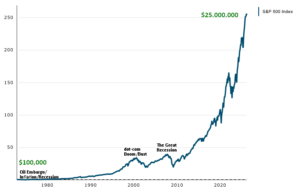
It is worthwhile to note that the longest it has ever taken an index investor to break-even, counting reinvested dividends, was the five-year, eight-month period from August 2000 through April 2006. (Source: Jeremy Siegel, Stocks for the Long Run, sixth edition (2023))
The market doesn’t always make its free-throws. And, sometimes those “clutch” three-point shots miss. But while these “misses” may show up as generalized (not infrequent) price declines, history has shown the US market’s overall resilience in bouncing back. Companies correct course, adapt and adjust to economic conditions. Given enough time, sentiments turn and market history has provided investors with recovery.
March Madness has us thinking about the parallels with the stock market ups and downs.
Know that we are watching the environment around us with you and keeping an eye on the bigger picture – basketball and markets alike. We may not pick every team in the sweet sixteen or the elite eight, but our proactive commitment to investment fundamentals is a path to a winning “bracket” of meeting your most important goals. Our investment discipline has had our team continuing to regularly review your financial plan and investment allocations, rebalancing portfolios in line with your unique goals and objectives. This is beneficial no matter the environment. For our retired clients and those taking regular portfolio distributions, we have endeavored to place a significant amount of your near-term distribution needs into “stability seeking” investments. If you want to talk about your plan specifically, please don’t ever hesitate to reach out. We are honored to be your financial partner and welcome those conversations.


